
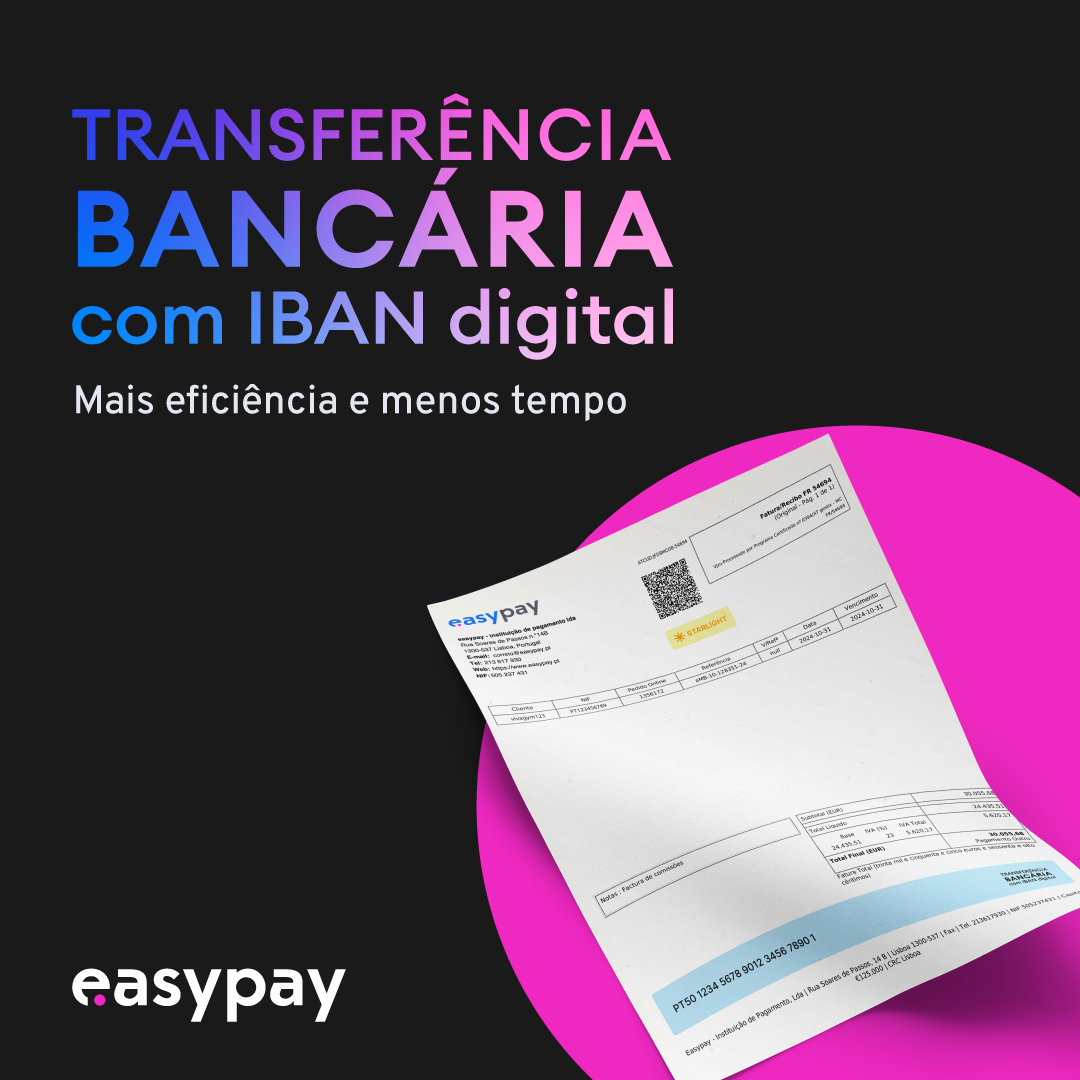
What is a virtual IBAN?
A virtual IBAN is an IBAN created to identify a customer, an invoice or a contract.
Instead of all customers paying into the same IBAN, each one gets their own. When the money arrives, the payment is automatically linked to the relevant customer or transaction.
For the payer, nothing changes: they simply enter the IBAN and the amount, as in a normal transfer. The difference is on the business side, which can now identify payments without manual work and without errors.
A virtual IBAN lets you receive transfers in euros within the SEPA area.
How does a virtual IBAN work?
- The business generates the IBAN: at checkout, via API or from the invoicing software, for each customer, invoice or payment.
- The customer receives the instructions: they see the IBAN and the amount to transfer, and can also receive them by email.
- The customer transfers from their online banking: with an instant transfer, the money arrives in seconds; a standard transfer can take up to the next working day.
- The payment is identified: when the money arrives, the system immediately links it to the customer, invoice or contract.
- The merchant is notified on D+1: they receive the payment notice and can view all the information in the backoffice.
Why are bank transfers so much work for the recipient?
Bank transfers remain one of the most widely used payment methods in Portugal. In 2025, they accounted for 46.9% of the value processed in the retail payment system, according to the Banco de Portugal.
The problem lies in identifying who has paid. In a traditional transfer, several customers send money to the same IBAN and reconciliation depends on what each one writes in the payment description.
If that information is missing or wrong, you have to ask for proof of payment, check statements and confirm amounts by hand, which delays reconciliation and the dispatch of orders.
What are the advantages of a virtual IBAN for your business?
- Automatic bank reconciliation. Each IBAN is linked to a customer, invoice or contract. When the payment comes in, on D+1 the system knows which transaction it belongs to, without cross-checking statements by hand.
- Fewer requests for proof of payment. The payment is identified by the IBAN itself and not by the description the customer writes. Your team no longer wastes time requesting and validating proof of payment.
- Immediate payment identification. With payment notifications, the status of an invoice, order or subscription is updated as soon as the money arrives.
- Greater privacy of bank details. The customer transfers to a virtual IBAN and does not need to know the business’s main account IBAN.
- For one-off or recurring collections. The virtual IBAN can be used for a single payment or stay linked to a customer or contract, for recurring payments.
- Simpler refunds.
Where can you use a virtual IBAN?
- Invoices and B2B payments: each invoice carries its own IBAN and the payment identifies itself. See how to integrate it into your invoicing software.
- Online stores and marketplaces: as a complement to other payment methods, through the plugins for online stores.
- Online course platforms: automatically identify the payment for each enrolment, plan or renewal.
- Donations: non-profit organisations can identify each contribution and where it came from.
What to consider before activating a virtual IBAN
A bank transfer requires the customer to go to their online banking, so it involves more friction than methods such as MB WAY. Ideally, you should offer it alongside other payment methods, depending on your customers’ profile.
Since payment is not immediate in every case, the order or service should only go ahead once receipt of the funds has been confirmed.
Integration with invoicing software also matters: by linking the IBAN and the payment status to each document, the company reduces manual tasks and keeps better control of outstanding amounts.
Frequently asked questions
Is a virtual IBAN a real IBAN? Yes. It has the format of a normal IBAN and receives SEPA transfers like any other. The funds are linked to the business’s account.
Does the customer need to do anything differently? No. They make a normal transfer in their online banking, to the IBAN they received.
How long does it take to confirm the payment? With an instant transfer, seconds. With a standard transfer, up to the next working day.
Can I use the same virtual IBAN for several payments from the same customer? Yes. You can assign one IBAN per customer or contract, for recurring payments, or one IBAN per invoice.
Activate easypay’s virtual IBAN in your business
With easypay’s virtual IBAN, each customer, invoice or contract has its own IBAN and bank reconciliation becomes automatic. All payment information is available in the backoffice.
You can activate it in two ways:
- Through the easypay checkout, if you already use it, by configuring it directly.
- Via API, to integrate it into your system.
By choosing easypay as your partner
By choosing easypay as their partner, merchants benefit from a solid platform adapted to the needs of the market. With plugins for various e-commerce platforms, such as Shopify, WooCommerce, VTEX, Wix or Magento, and simplified refund support, the Virtual IBAN is the ideal choice for optimising bank reconciliation.
Cegid Primavera is an excellent choice for invoicing management in Portugal, and with the easypay add-on, this software offers even more flexibility and convenience. Integrating the Virtual IBAN into the Cegid Primavera platform allows businesses to automate bank reconciliation effectively, removing the need for manual payment identification processes. By linking a unique IBAN to each customer or invoice, the system automatically identifies incoming transfers, ensuring more accurate and up-to-date financial management. With easypay and Cegid Primavera, merchants have access to a complete solution that brings invoicing management and payment processing together in a single environment, improving control of accounts and the payment experience for customers.


